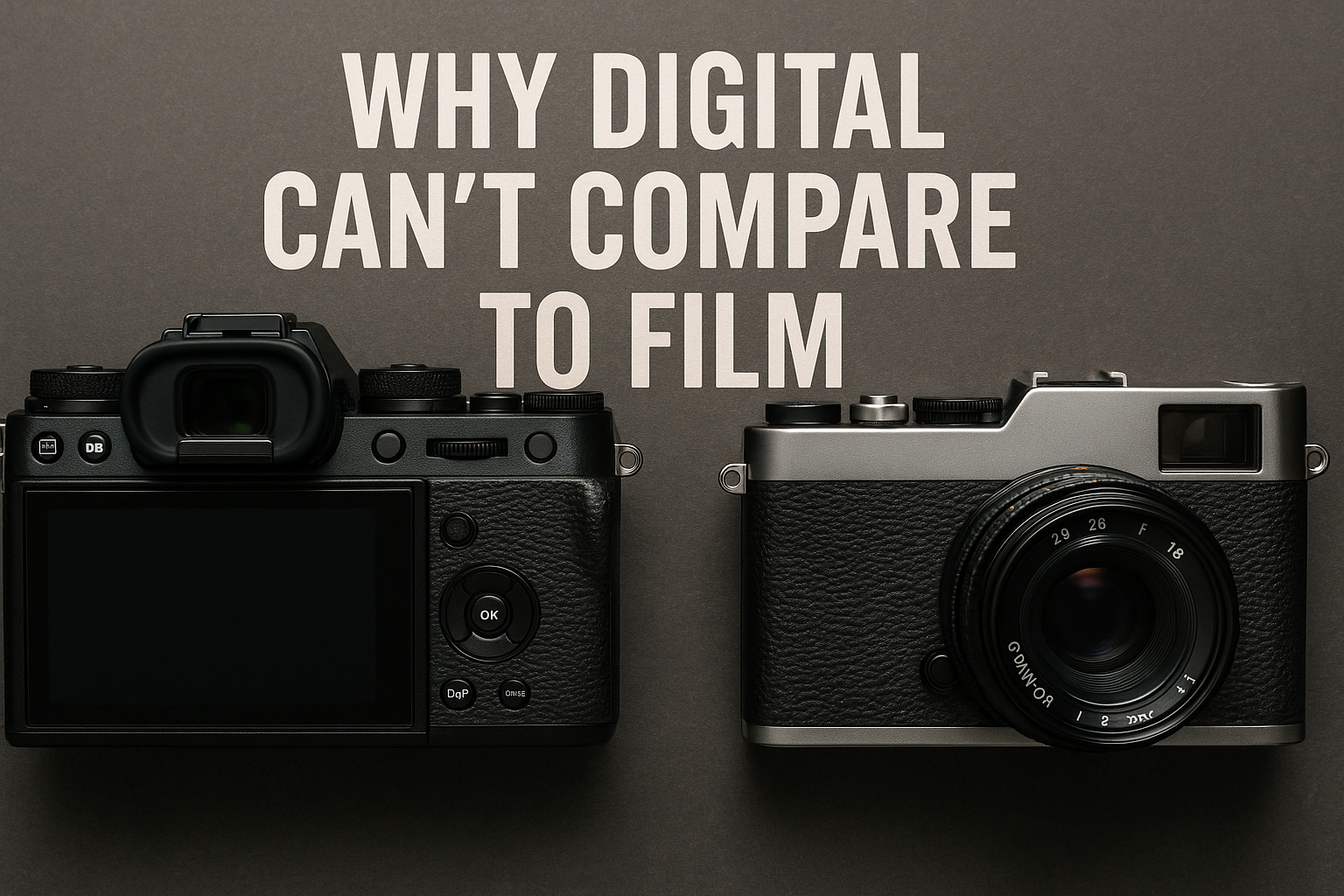
• Great question — and one that’s sparked endless debates among photographers! The answer really depends on what you’re comparing: image quality, experience, or even emotional impact. Here’s a breakdown of why some people feel digital cameras can’t compare to film cameras, especially classic or high-end ones:


    🎞️ 1. The Look and Feel of Film

    • Color and Grain: Film has a unique way of rendering colors and grain. There’s often a richness, depth, or subtle imperfection that feels “organic” or “alive.” Digital sensors sometimes look too clean or clinical by comparison.
    • Dynamic Range: High-quality film stocks (like Kodak Portra or Fuji Pro 400H) can handle highlights gracefully, especially skin tones. Some argue digital tends to blow out highlights too easily — though modern sensors have improved a lot here.

    📷 2. The Experience of Shooting Film

    • Intentionality: You get 36 shots (or fewer), not thousands. That limitation forces you to slow down and really think about each frame.
    • Tactile Feedback: The mechanical feel of winding film, the sound of a shutter in an old Leica or Nikon F3, is deeply satisfying. Digital often feels… less soulful.
    • Delayed Gratification: With film, you can’t chimp (check your shot right after you take it). That mystery adds magic — and sometimes surprise — to the process.

    🧪 3. Archival Quality

    • Longevity: Properly stored film negatives can last 100+ years and be rescanned at higher resolutions as technology improves. Digital files risk bit rot or obsolescence without careful backup.

    🧠 4. Psychological and Cultural Weight

    • Film photography has historical prestige. Many iconic images were shot on film, giving it a legendary aura.
    • There’s also nostalgia. Film evokes a different era — not just technologically, but emotionally.

    📸 But To Be Fair… Digital Is Incredible

    • Convenience: Instant feedback, huge memory cards, low-light performance, and high ISO capabilities.
    • Flexibility: Shoot in RAW, tweak endlessly, and share in seconds.
    • Cost: Once you own the camera, there’s no ongoing cost like film and developing.


  • Have you ever wondered how AI can turn your imagination into a real visual concept?

    Recently, I had a fun experience creating a custom “Snowman Car” toy model — and even adding a “Snowdog” beside it — using ChatGPT and AI image generation. Here’s how it worked:

    Step 1: The Idea

    It all started with a simple idea:

    I wanted a cute snowman sitting in a small toy car, just like the “Jellycat Egg Car” collectible by Tomica.

    Later, I thought: why not add a snowdog to make it even cuter?

    Step 2: Uploading Inspiration Images

    I shared two pictures with ChatGPT:

    • One picture of the Jellycat Egg Car toy for style reference.
    • One picture of The Snowman and Snowdog characters from the famous British animation.

    These gave the AI a clear idea of the style, mood, and characters I wanted.

    Step 3: Giving Clear Instructions

    I simply told ChatGPT:

    • Keep the Snowman in the car.
    • Make the Snowman’s car look small, cute, and similar to the Jellycat Egg Car.
    • Add the Snowdog beside or near the Snowman.
    • Make it feel like a Tomica-style toy box (with packaging).

    No complicated setup — just natural conversation.

    Step 4: AI Image Generation

    ChatGPT then used a connected image generation tool (like DALL·E) to visualize my instructions.

    It created a custom, realistic-looking toy set showing:

    • The Snowman driving a light blue toy car.
    • The Snowdog happily standing nearby.
    • Tomica-style box underneath, just like a real collectible toy.

    It perfectly matched the feeling of a real product, even including small packaging details like:

    • The Tomica logo (トミカ).
    • The product number (120).
    • The description (“Snowman Car”) in English and Japanese.
    Step 5: Refinement (Optional)

    If I wanted any changes (for example, different car color, or Snowdog sitting inside the car), I could simply tell ChatGPT, and it would update the design in seconds.


    Why This Is Amazing

    Normally, designing a collectible toy would need:

    • A 3D artist,
    • A graphic designer,
    • A photographer,
    • A product packaging specialist.

    But now, with AI + a little imagination, you can create a concept within minutes — just by describing it in plain language.

    It’s fastcreative, and accessible to anyone, even if you don’t know how to draw!


    Final Thoughts

    ChatGPT is not just for chatting — it can bring your ideas to life visually too.

    Whether you want to design a toy, imagine a new product, or just have fun creating fantasy collectibles, AI tools like this make the process simple, exciting, and magical.

    Next time you have a crazy idea in your head, don’t keep it locked away —

    talk to ChatGPT, and watch it become real!


  • Alright, let’s break it down simply:

    This is a lens cross-section diagram — it shows the inside optical structure of a camera lens.

    Specifically, this is the NIKKOR Z 35mm f/1.2 S lens from Nikon (you can read it on the side of the lens body).

    What you are seeing:

    • Blue shapes = individual lens elements (the glass inside the lens).
    • White lines = light rays traveling through the lens from left (front) to right (camera sensor side).
    • The curved white lines = how the lens bends (refracts) light.
    • The straight white line = the optical axis (center path through the lens).

    Why it’s important:

    • You can see how complex the lens design is: many elements are used to:
      • Correct aberrations (color fringing, distortion, etc.)
      • Achieve sharpness across the frame.
      • Allow a large aperture (f/1.2) for great low-light performance and shallow depth of field.
    • The light paths cross and refocus toward the image sensor — this shows how the lens gathers and corrects light into a sharp point.

    Super quick summary:

    PartMeaning
    Blue shapesGlass elements inside the lens
    Straight white lineCentral optical path
    Curved white linesLight bending through the lens
    Light crossing at centerFocus point for sharp images

  • 這個話題很有深度。

    我來為你做一個有條理的「台灣攝影歷史」概述,按照時間順序,並細分幾個重要時期來講解:

    一、清朝末期(19世紀中期到1895年)

    攝影初傳入台灣 攝影技術在19世紀中期隨著西方傳教士、商人和探險家傳入台灣。最早的攝影活動多集中在外國人紀錄台灣自然景觀、原住民生活與人文地貌,例如:英國攝影師 John Thomson 在1871年拍攝的《Formosa》系列,記錄了當時的台灣社會風貌。 攝影作為殖民記錄 當時攝影主要是用來記錄異域文化和地理資料,並且服務於航海、商業和傳教工作。一般台灣本地人並未普遍接觸攝影技術。

    二、日本統治時期(1895–1945)

    攝影技術普及與專業化 1895年《馬關條約》後,日本統治台灣。日本將當時的現代攝影技術引入台灣,成立了官方攝影單位如「總督府」,負責地誌調查、建設紀錄等。 攝影成為政府治理與教育的重要輔助工具,也促成了台灣第一批本地攝影師的誕生。 攝影社團與展覽活動興起 1930年代,台灣出現了第一個攝影組織「台灣寫真研究會」,後來也有「台灣攝影會」。攝影成為一種愛好與藝術表現。 當時流行「沙龍攝影」(Salon Photography),重視藝術性、構圖與光影美感。攝影比賽與展覽(如「台展」)也開始出現,台灣攝影師的作品甚至能在日本本土展覽中獲獎。 重要攝影家 張才(Chang Tsai):日治末期開始活動,戰後成為重要紀實攝影代表。

    三、戰後至1960年代(1945–1960s)

    國民政府接管,攝影重建期 1945年日本戰敗,國民政府接收台灣。初期社會動盪,攝影活動一度沉寂。 1950年代後,隨著社會穩定與經濟復甦,攝影活動重新活絡起來。 報導攝影興起 台灣新聞媒體迅速發展,報導攝影(如:社會新聞、政治事件記錄)需求大增。攝影成為記錄社會變遷的重要手段。 紀實攝影的開端 張才拍攝《台灣人間》系列,深入反映庶民生活,成為台灣紀實攝影的重要起點。

    四、1970–1980年代:攝影多元化與本土意識興起

    攝影社團爆發式成長 包括中華攝影藝術學會、台北攝影學會等眾多團體成立。沙龍攝影仍然盛行,但越來越多攝影師開始反思,轉向關注社會、土地與人民的題材。 本土紀實運動 台灣社會運動興起,攝影師參與政治、環保、工運等紀錄,攝影成為一種行動與發聲的工具。 如「影言社」成員(劉振祥、阮義忠等)推動了以人為本的紀實攝影。 重要出版 阮義忠編輯的《人間》雜誌(1980年代)推動了台灣紀實攝影發展,影響深遠。

    五、1990年代至今:數位化與全球化時代

    數位攝影普及 進入21世紀,數位相機與手機攝影普及,改變了攝影生產與分享的方式。 網路、社群平台(如Instagram、Flickr)成為新一代攝影師發表作品的重要場域。 攝影藝術化、多元化發展 攝影跨界與當代藝術、裝置藝術、影像敘事結合,題材更自由、手法更多元。 國際交流增加 台灣攝影師如吳家昇、張雍等,在國際攝影展和媒體上嶄露頭角。 近年也有更多攝影節活動,如「台北攝影節」、「高雄攝影節」,推動攝影在大眾中的普及與討論。

    代表性人物速覽

    時期攝影家特點
    日治時期張才紀實攝影先驅,生活紀錄
    戰後鄧南光台灣早期紀實、人物攝影
    1980年代阮義忠推動紀實攝影,出版《人間》
    當代張雍、吳家昇、莊靈當代攝影藝術與紀實結合

  • Great question — and one that’s been seriously shifting in the last few years. Canon used to be the undisputed king of digital camera development, but as of 2025, the crown is shared, challenged, and constantly evolving.

    Here’s the real state of play in digital camera development:


    Where Canon Still Leads (or Competes at the Top)

    1. Lens Ecosystem

    • RF-mount lenses are top-tier in sharpness, speed, and innovation.
      • The RF 28-70mm f/2L, RF 135mm f/1.8L, and RF 85mm f/1.2L are optical monsters.
      • Canon is pushing exotic optics faster than almost anyone right now.

    2. Color Science

    • Canon’s color output is still beloved by portrait and video shooters.
    • Skin tones = chef’s kiss. 🎨

    3. Reliability & Usability

    • Canon bodies are workhorses.
    • Autofocus, ergonomics, and menus are user-friendly and rock-solid.

    4. Video Innovations

    • Canon cinema line + RF hybrid bodies (like R5 C, R6 Mark II) are excellent.
    • Canon Log profiles and RAW video support are pro-level.

    Where Canon Is No Longer Dominant

    1. Sensor Innovation

    • Sony and Nikon (using Sony sensors) are leading in:
      • Dynamic range
      • Low light performance
      • Global shutter (Sony a9 III — game-changer!)
    • Canon’s sensors have improved, but they’re not at the top of the food chain.

    2. Autofocus Tech

    • Canon’s Dual Pixel AF is amazing — but Sony’s Real-Time Tracking AF and AI-driven subject recognition (especially with birds, cars, and insects) is next level.

    3. Computational Imaging

    • Nikon’s Z9 and Z8 have industry-leading in-camera processing features.
    • Sony’s a1 and a9 III are pushing AI and speed beyond traditional DSLRs.

    4. Third-Party Lens Support

    • Canon is restrictive with RF lens licensing, limiting third-party options.
    • Sony and Nikon are more open, giving them broader ecosystems.

    🏆 So Who’s “King” in 2025?

    BrandCrown Type
    CanonLens R&D, color science, reliability
    SonySensor tech, autofocus, innovation pace
    NikonBest pro cameras (Z9, Z8), usability, lenses
    FujifilmAPS-C creativity, film simulations
    PanasonicHybrid video (S5II, GH6), open L-mount

    Canon is still elite, no question. But it’s no longer alone at the top — now it’s a three-horse race with Sony and Nikon right beside it.


    Want a specific comparison? I can do Canon vs. Nikon Z9, or R5 vs. Sony a7R V, etc. Let me know what you’re eyeing.

  • Pentax surviving in 2025 is honestly kind of amazing — but it makes sense when you look closer. They’ve carved out a niche that’s passion-driven and built around dedication to the DSLR and analog experience, not the mainstream mirrorless race. Here’s why they’re still around:


    1. They’re the Last DSLR Holdouts

    While Canon and Nikon have mostly gone mirrorless, Pentax doubled down on DSLRs, which actually attracted a loyal crowd of shooters who prefer OVFs and traditional camera handling.

    • Pentax K-3 Mark III is a prime example — fast, solid, and still getting firmware updates.
    • They’re now working on a new compact film camera, which is feeding into the analog revival.

    2. Cult Following

    Pentax users aren’t casual — they’re die-hard fans. They love the brand’s philosophy: weather sealing, in-body stabilization, rugged bodies, great color science, and total independence.

    • You won’t find many Pentax users jumping ship unless the company literally disappears.

    3. Film Comeback

    Pentax is banking on film photography. They announced a project to bring back a brand-new film camera system — something no other big brand has done seriously in years.

    • That makes them culturally relevant to younger photographers seeking that analog experience.

    4. Unique Tech & Features

    They do things their own way:

    • Built-in Astrotracer (for astrophotography without a tracker)
    • Pixel shift resolution
    • Tactile controls and well-thought-out ergonomics
    • IBIS in a DSLR? Only Pentax.

    5. Ricoh’s Patient Strategy

    Ricoh (which owns Pentax) isn’t pushing volume — they’re taking the “slow brand” approach: low-cost R&D, long product cycles, zero hype marketing, and they still turn a small profit. It’s a sustainable, quiet model.


    ✨ TL;DR:

    Pentax survives not in spite of being different — but because it’s different. In a world of high-speed mirrorless churn, they offer a slower, more tactile, more deliberate experience, and there’s still a market for that.

    Exactly — that’s one of Pentax’s biggest flexes. Their camera design is rock solid, and they’re all about precision shooting over flashy specs. Let’s unpack that a bit:


    🧱 Solid Design Philosophy

    • Weather sealing on almost every body — even entry-level models. That’s rare.
    • Magnesium alloy frames, deeply sculpted grips, and intuitive button layouts. They feel like tools, not gadgets.
    • Even their kit lenses are WR (weather-resistant), which is something most brands reserve for high-end glass.

    🎯 Accurate Shooting Quality

    Pentax doesn’t chase top numbers on spec sheets, but they deliver real-world results:

    • In-body image stabilization (IBIS) that works with every lens — prime or zoom, old or new.
    • Excellent metering and auto white balance, especially under mixed lighting.
    • Pentax color science is beloved — natural, film-like tones, especially in the greens and reds.
    • Custom image profiles like “Bright,” “Reversal Film,” and “Bleach Bypass” add creative options straight out of camera.

    📸 User-Centric Experience

    They design cameras for people who want to be involved in the image-making process:

    • Big, bright pentaprism viewfinders (not cheap pentamirrors).
    • Deep menu customization and physical controls where it counts.
    • Pixel Shift Resolution for insane detail in landscapes and studio work — pure nerd magic.

    In short, Pentax is all about giving you a dependable, immersive experience where you’re in control — and the gear will back you up in any weather or shooting condition. It’s built for people who love the act of photography.

    Do you shoot Pentax yourself, or are you just a fan of the brand’s vibe?

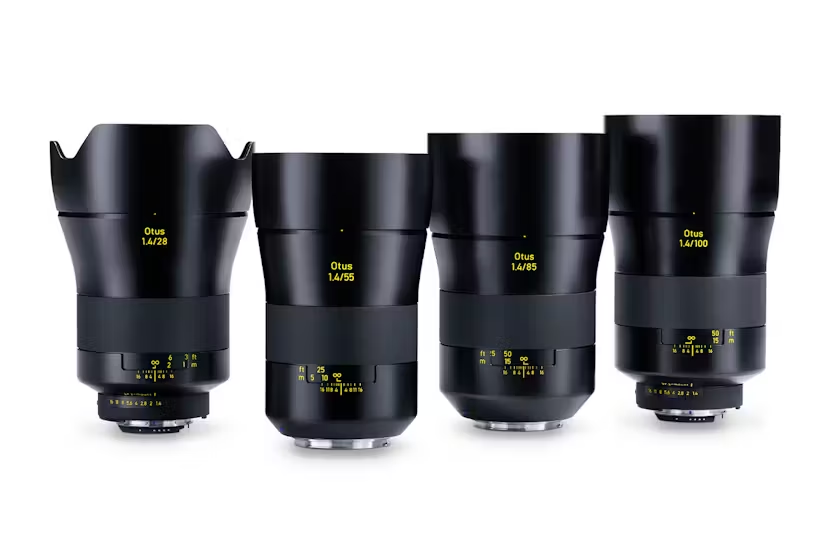
  • Oh yeah — Zeiss is legendary for a reason, and their lens design philosophy is honestly a masterclass in optical engineering. Let’s get into how Zeiss approaches lens design, both in terms of philosophy and technical process:


    🔬 Zeiss Lens Design: The Art + Science

    1. Design Philosophy

    • “Resolution is not everything”: Zeiss cares deeply about microcontrast, color fidelity, and 3D pop — not just lab-measured sharpness.
    • Human visual perception is a huge part of the process — they design lenses that look beautiful, not just clinically sharp.
    • Mechanical precision: Their housings (especially Otus, Batis, Loxia, and classic ZM lines) are made with aerospace-grade metal and mechanical parts that last decades.

    2. Optical Engineering Process

    Zeiss follows a rigorous, multi-stage process to design their lenses:

    a. Initial Concept + Purpose

    • Each lens starts with a mission: Is it for cinema? Macro? Scientific use? Portraits?
    • Based on that, they choose design criteria like:
      • Max aperture
      • Coverage (full-frame, APS-C, medium format)
      • Weight/size constraints
      • Price vs performance

    b. Optical Formula Selection

    Zeiss has pioneered or refined many lens designs over the years. Depending on goals, they might choose from classic formulas:

    Lens Design TypeCharacteristics
    PlanarSymmetrical, very low distortion, sharp
    SonnarHigh-speed, compact, good bokeh
    DistagonWide-angle, low aberration, floating elements
    Otus (customized)Exotic, no-compromise modern designs
    BiogonRangefinder-friendly, minimal distortion

    They use ray tracing, optical simulation, and thousands of iterations in software like ZEMAX to simulate performance before a prototype even exists.

    c. Material Selection

    • Zeiss uses ultra-high-quality glass from Schott, their sister company.
    • Special elements include:
      • ED glass
      • Aspherical elements
      • Apochromatic correction (APO) for color purity
      • Floating elements for consistent sharpness across focus range

    d. Prototype & Refinement

    • Physical prototypes are made and tested in:
      • MTF bench tests
      • Real-world field tests (sometimes by photographers)
      • Temperature/humidity stress testing

    e. Mechanical Design

    • All-metal barrels with precision helicoids.
    • Long-throw focus rings (especially for cine lenses or Otus).
    • Weather sealing depends on line (Batis = sealed, Otus = not sealed).

    3. Zeiss Lens Lines (Modern)

    • Otus – No compromise, manual focus, best optics in DSLR format.
    • Batis – For Sony E-mount, autofocus, lightweight, weather-sealed.
    • Loxia – Compact MF lenses for Sony E with cinematic rendering.
    • Milvus – EF/Nikon F-mount, updated coatings + housing.
    • Touit – For APS-C (Sony/Fuji), compact but premium.
    • ZM – Leica M-mount lenses, classic Zeiss look.

    4. Signature Look (a.k.a. The Zeiss Pop)

    • High microcontrast
    • Natural color rendering
    • Smooth but structured bokeh
    • That sense of “depth” even in 2D images — a result of great separation + contrast.

    Want a peek into a specific lens design? I can break down the element groups in something like the Zeiss Otus 85mm or Batis 40mm if you’re curious how those are built internally.

  • When it comes to sharpest lenses in the world, the answer depends a bit on what you’re measuring — lab results, real-world use, focal length, etc. But there are a few lenses that consistently come up as legendary for sharpness. Here’s a breakdown by category:


    🥇 Overall Sharpness King (Lab Tested)

    Zeiss Otus 55mm f/1.4

    • Mounts: Canon EF / Nikon F
    • Why: Often referred to as the sharpest DSLR lens ever made. No distortion, perfect microcontrast, ultra-crisp edge-to-edge.
    • Downside: Manual focus only, very expensive, and huge.

    🔬 Mirrorless Marvel

    Sigma 50mm f/1.4 DG DN Art (Sony E / L-mount)

    • One of the sharpest modern autofocus lenses for full-frame mirrorless.
    • Lighter and cheaper than the Otus, but with performance that’s very close in practical terms.

    📸 Highest Resolving Lens (Tested for Sensors)

    Canon RF 135mm f/1.8L IS USM

    • For portrait shooters, this lens is insanely sharp even wide open.
    • Arguably the sharpest Canon RF lens to date.

    🧪 Insanely Sharp Wide-Angle

    Laowa 15mm f/2 Zero-D

    • Ultra-wide but crazy sharp corner to corner, with nearly zero distortion.
    • Great for architecture and astrophotography.

    🛰️ Sharpest Lens Ever Made (Non-Consumer)

    NASA Zeiss 250mm f/5.6 Superachromat

    • Made for NASA, medium format, used with Hasselblad systems in space.
    • Insanely corrected for chromatic aberration.
    • Obscenely rare.

    🏆 Honorable Mentions

    • Sony FE 24mm f/1.4 GM – Unbelievable sharpness + light weight.
    • Fujifilm XF 56mm f/1.2 R WR – For APS-C, it’s razor sharp.
    • Leica APO-Summicron-M 50mm f/2 ASPH – Basically flawless, but $$$.

    Do you want sharpness for portrait, landscape, macro, or a certain camera system? I can narrow it down even more.

  • Netflix is testing a new search feature powered by OpenAI technology that aims to improve how users discover content on the streaming platform, according to multiple reports.


    Netflix is testing a new AI-powered search tool that lets users look for shows and movies using natural, conversational language—going beyond the usual searches by genre or actor. According to Bloomberg, this new feature will allow people to search based on more nuanced criteria, such as their current mood.

    Netflix spokesperson MoMo Zhou confirmed to The Verge that the feature is currently being tested with a limited number of users in Australia and New Zealand on iOS devices. The company plans to expand testing to the U.S. “in the coming weeks and months,” although there are no immediate plans to bring it to platforms beyond iOS.

    During Netflix’s Q1 earnings call, CEO Greg Peters emphasized the need to enhance how users discover content on the platform.

    “There’s still room to improve discovery and recommendations, which adds value for members and helps our titles reach the largest possible audiences,” Peters said.

    The AI search feature is currently opt-in, reflecting a cautious rollout. “It’s early days—we’re really in a learn-and-listen phase with this beta,” Zhou added.

    This new feature is part of a broader push to improve the user experience, including a major redesign of the TV app homepage—the first significant interface update in over 10 years, according to Peters. The redesign is expected to launch later this year.

    While Netflix has long used AI and machine learning to power its recommendation engine, this marks a significant step into generative AI.

    Co-CEO Ted Sarandos has noted that AI can enhance filmmaking processes, but won’t replace creatives like writers or actors—a key concern in Hollywood, where the rise of AI has sparked fears about job security and production costs.

    Netflix also reported a strong start to the year, with Q1 revenue up 12.5% year-over-year to $10.54 billion.


    Let me know if you want this to sound more formal, casual, or tailored to a specific audience (e.g., press release, internal memo, blog post).

  • Screenshot

    If you’re venturing into the world of Leica, understanding the brand’s unique terminology is essential. Leica’s naming conventions and technical terms reflect its rich heritage and commitment to precision. Here’s a comprehensive guide to help you navigate Leica’s distinctive language:


    🔍 Leica Lens Nomenclature

    Leica lenses often carry names that denote their maximum aperture and design characteristics

    • Summicron:Lenses with a maximum aperture of f/2
    • Summilux:Lenses with a maximum aperture of f/1.4
    • Noctilux:Ultra-fast lenses, typically with apertures of f/1.0 or wider, designed for low-light photography
    • Elmarit:Lenses with a maximum aperture of f/2.8
    • Elmar:Traditionally, lenses with a maximum aperture of f/3.5 or f/4
    • Summarit:Initially used for f/1.5 lenses; later revived for more affordable lenses with apertures around f/2.4
    • APO:Stands for “apochromatic,” indicating lenses corrected for chromatic aberrations across the visible spectrum
    • ASPH:Denotes lenses that incorporate aspherical elements to reduce optical aberrations
    • Macro-Elmar:Compact macro lenses designed for close-up photography
    • Elpro:Close-up lens attachments that reduce the minimum focusing distance of compatible lenses

    📷 Leica Camera Systems and Mounts

    Leica’s camera systems are categorized by their mounts, each tailored for specific photography need:

    • M-Mount Introduced in 1954, this bayonet mount is used in Leica’s rangefinder cameras, known for their compactness and manual focus precisio.
    • R-Mount Designed for Leica’s SLR cameras, the R-mount supported a range of manual focus lense.
    • S-Mount Used in Leica’s medium format digital S-series cameras, offering high-resolution imaging for professional application.
    • L-Mount A versatile mount developed for Leica’s mirrorless cameras, available in two version:
      • TL For APS-C sensor camera.
      • SL For full-frame sensor camera. The L-Mount Alliance, formed in 2018, includes Leica, Panasonic, and Sigma, promoting cross-brand compatibilit. cite turn0search21

    🛠️ Technical Terms and Accessories

    • **Rangefinder (RF)*: A focusing mechanism where the photographer aligns two images to achieve focus, characteristic of Leica M-series camers
    • *Visoflex: An accessory that converts rangefinder cameras into SLRs, allowing for through-the-lens viewing and focusig.
    • *Ocular To-R: An adapter that transforms R-series lenses into spotting scopes, incorporating a prism system for correct image orientatin. citeturn0search0

    🏷️ Iconic Leica Terms

    • *Red Dot: Refers to the distinctive red Leica logo found on many of its cameras and lenses, symbolizing the brand’s identity and prestge.
    • *Q: Denotes Leica’s line of fixed-lens full-frame compact cameras, starting with the Leica Q (Typ 16). citeturn0search0

    Understanding these terms will enhance your appreciation of Leica’s craftsmanship and the precision engineering that defines its produts. Whether you’re a seasoned Leica user or new to the brand, this glossary serves as a valuable reference to navigate the Leica ecosystem.