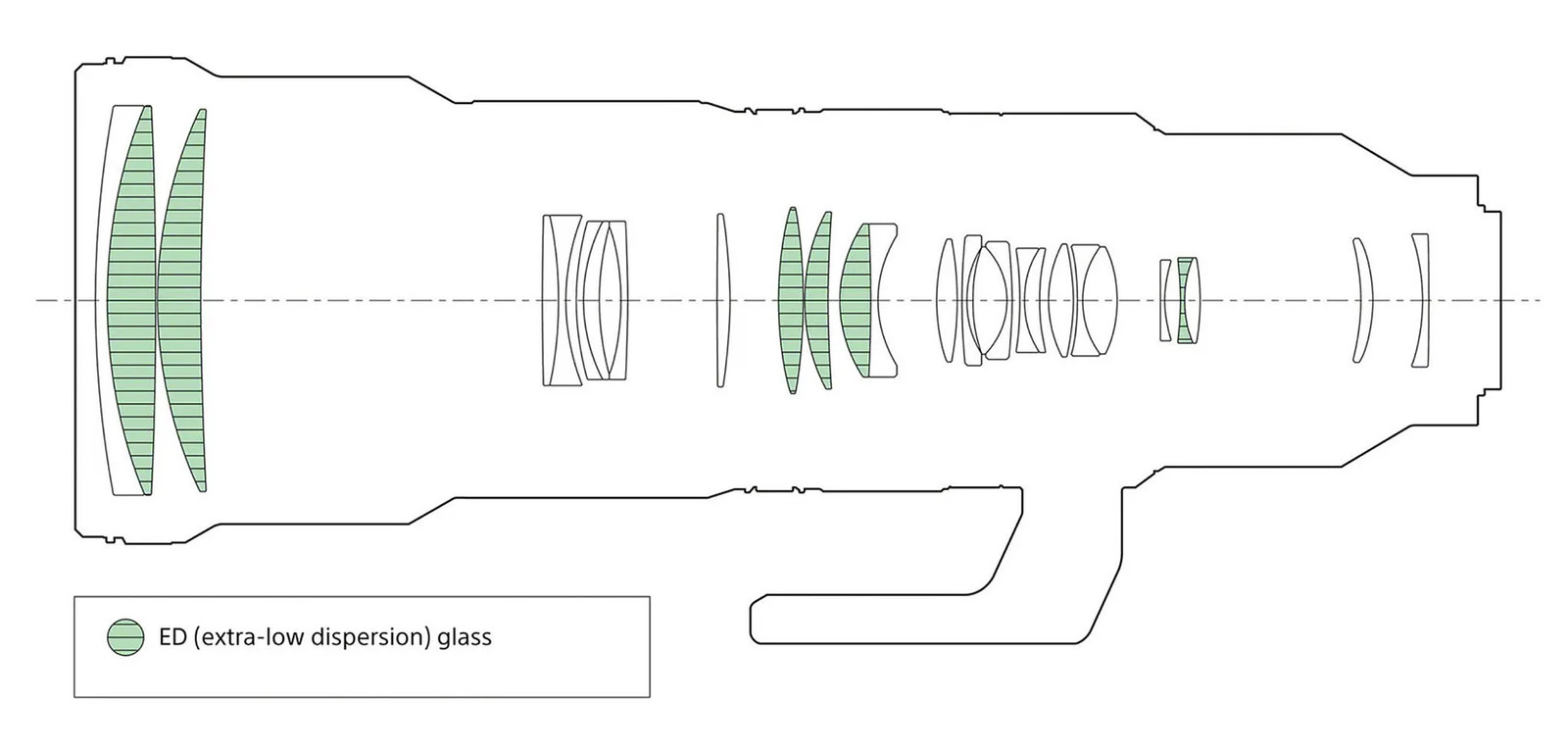
This is a lens construction diagram for a Sony 400-800mm super-telephoto zoom lens, likely aimed at wildlife and sports photographers. Let’s break down the design based on what we can see in the optical layout:
🔍 General Observations
- Lens Type: Super-telephoto zoom (400–800mm)
- Construction Style: Internal zooming, front-heavy design (common in long primes/zooms)
- Tripod Collar: The handle shape on the underside suggests a tripod collar for stability.
🧠 Optical Element Analysis
- ED Glass Elements (Green):
The diagram indicates multiple ED (Extra-low Dispersion) glass elements. These are crucial in reducing chromatic aberration, especially in long telephoto lenses where color fringing can be problematic.- Front Group: Two large, paired ED elements right at the front help suppress CA early in the optical path.
- Middle Group: A cluster of 3 ED elements around the zoom group — this section likely handles the focal length transition from 400 to 800mm.
- Rear Group: A small ED element is placed in the rear optical group, likely helping correct residual aberrations before the image reaches the sensor.
🔁 Zoom and Focus Mechanism
- Zooming Section (Mid-body):
There’s a symmetrical-looking lens group likely moving back and forth to control focal length. Since it’s a 2x zoom, expect minimal barrel extension or internal zooming — good for weather-sealing. - Internal Focus System (Rear):
Toward the rear, there’s a smaller moving group — probably the focus group — which is common in telephoto designs to avoid moving the front-heavy elements.
⚙️ Design Characteristics
- Modular Grouping: The optical layout is divided into distinct blocks — front (light gathering), middle (zoom control), and rear (focusing and correction).
- High Correction Priority: The presence of 6+ ED elements suggests a strong emphasis on controlling aberrations and achieving high image clarity across the zoom range.
- Teleconverter Compatibility: Given the internal space and rear optical design, it’s likely designed to support Sony’s 1.4x and 2.0x teleconverters.
🎯 Performance Implications
- Sharpness: With this many ED elements and a complex design, it’s clearly optimized for professional-level resolution, even at 800mm.
- Bokeh & Contrast: The front group’s large, curved elements will help produce smooth bokeh while maintaining high contrast — vital for isolating distant subjects.
- Weight Distribution: Most of the heavy glass is in the front half — common for long telephotos — but the internal focusing group near the rear helps balance the lens better on a tripod.
 Camera News
Leave a comment