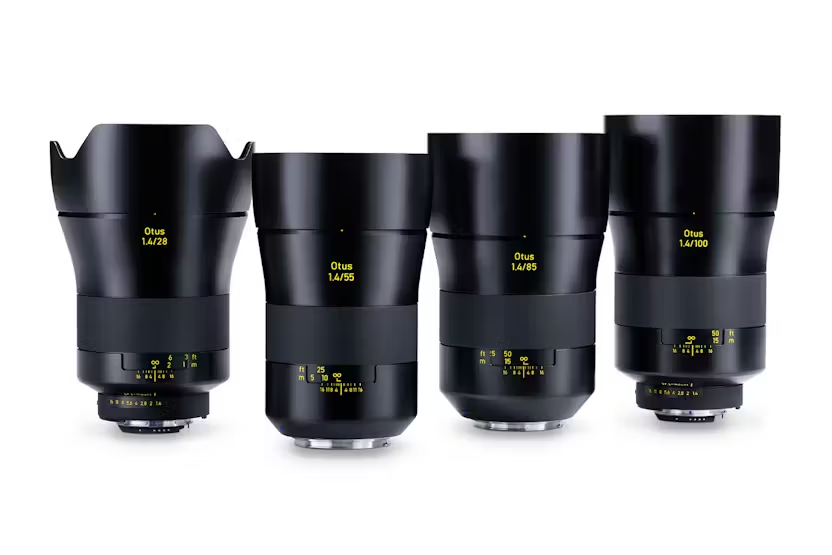
Oh yeah — Zeiss is legendary for a reason, and their lens design philosophy is honestly a masterclass in optical engineering. Let’s get into how Zeiss approaches lens design, both in terms of philosophy and technical process:
🔬 Zeiss Lens Design: The Art + Science
1. Design Philosophy
- “Resolution is not everything”: Zeiss cares deeply about microcontrast, color fidelity, and 3D pop — not just lab-measured sharpness.
- Human visual perception is a huge part of the process — they design lenses that look beautiful, not just clinically sharp.
- Mechanical precision: Their housings (especially Otus, Batis, Loxia, and classic ZM lines) are made with aerospace-grade metal and mechanical parts that last decades.
2. Optical Engineering Process
Zeiss follows a rigorous, multi-stage process to design their lenses:
a. Initial Concept + Purpose
- Each lens starts with a mission: Is it for cinema? Macro? Scientific use? Portraits?
- Based on that, they choose design criteria like:
- Max aperture
- Coverage (full-frame, APS-C, medium format)
- Weight/size constraints
- Price vs performance
b. Optical Formula Selection
Zeiss has pioneered or refined many lens designs over the years. Depending on goals, they might choose from classic formulas:
| Lens Design Type | Characteristics |
|---|---|
| Planar | Symmetrical, very low distortion, sharp |
| Sonnar | High-speed, compact, good bokeh |
| Distagon | Wide-angle, low aberration, floating elements |
| Otus (customized) | Exotic, no-compromise modern designs |
| Biogon | Rangefinder-friendly, minimal distortion |
They use ray tracing, optical simulation, and thousands of iterations in software like ZEMAX to simulate performance before a prototype even exists.
c. Material Selection
- Zeiss uses ultra-high-quality glass from Schott, their sister company.
- Special elements include:
- ED glass
- Aspherical elements
- Apochromatic correction (APO) for color purity
- Floating elements for consistent sharpness across focus range
d. Prototype & Refinement
- Physical prototypes are made and tested in:
- MTF bench tests
- Real-world field tests (sometimes by photographers)
- Temperature/humidity stress testing
e. Mechanical Design
- All-metal barrels with precision helicoids.
- Long-throw focus rings (especially for cine lenses or Otus).
- Weather sealing depends on line (Batis = sealed, Otus = not sealed).
3. Zeiss Lens Lines (Modern)
- Otus – No compromise, manual focus, best optics in DSLR format.
- Batis – For Sony E-mount, autofocus, lightweight, weather-sealed.
- Loxia – Compact MF lenses for Sony E with cinematic rendering.
- Milvus – EF/Nikon F-mount, updated coatings + housing.
- Touit – For APS-C (Sony/Fuji), compact but premium.
- ZM – Leica M-mount lenses, classic Zeiss look.
4. Signature Look (a.k.a. The Zeiss Pop)
- High microcontrast
- Natural color rendering
- Smooth but structured bokeh
- That sense of “depth” even in 2D images — a result of great separation + contrast.
Want a peek into a specific lens design? I can break down the element groups in something like the Zeiss Otus 85mm or Batis 40mm if you’re curious how those are built internally.
 Camera News
Leave a comment